


Demonic Possession or Epilepsy? From Superstition to the Science of Seizures
admin
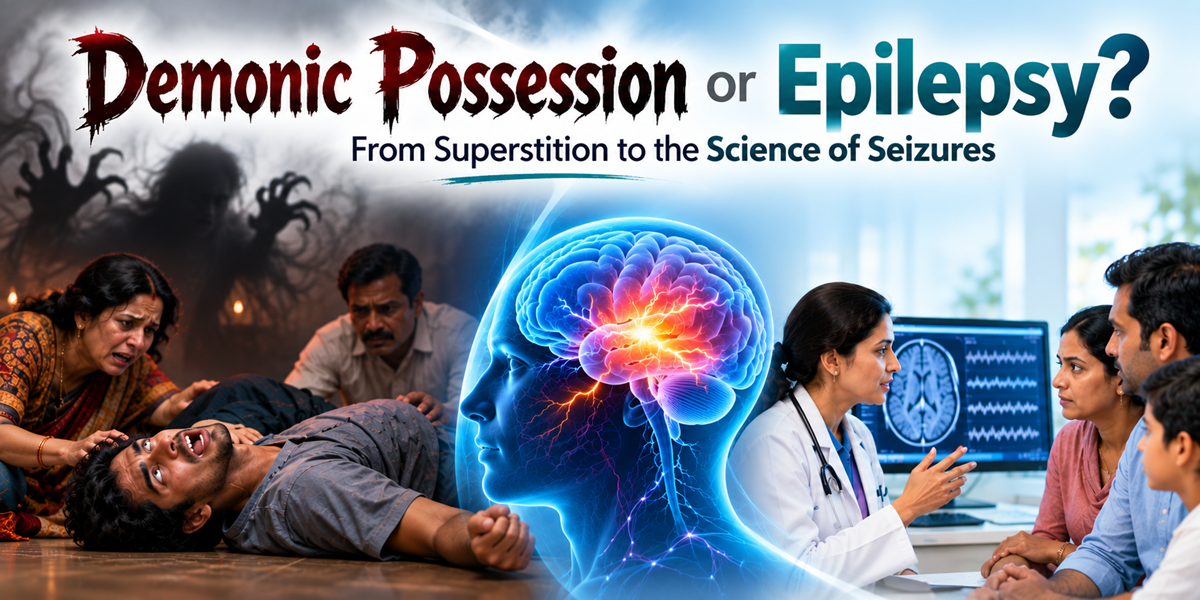
By Dr Haseeb Hassan, Senior Neurologist and Epilepsy Specialist, Kolkata
For centuries, seizures have been mistaken for supernatural encounters. Understanding the science behind them can help replace fear and stigma with knowledge, compassion, and timely medical care.
Can Epilepsy Be Mistaken for Demonic Possession?
Yes. Some epileptic seizures can cause convulsions, altered awareness, repetitive movements, sudden fear, or unusual sensory experiences. These manifestations may be misinterpreted as supernatural possession. However, they arise from neurological processes, and proper medical assessment is essential to establish the cause.
In my practice as a neurologist and epilepsy specialist, I have encountered a challenge that goes beyond diagnosing seizures or prescribing medication. It is the challenge of helping people understand what they have witnessed—and reconsider beliefs they may have held for generations.
Three Scenes, Different Seizures, One Common Fear: An Evil Spirit
Imagine a young man sitting with his family at dinner when, without warning, he lets out a strange cry and collapses to the floor. His body stiffens, and his arms and legs begin jerking violently. His mother screams his name while his father struggles to understand what is happening. Someone rushes forward to hold him down; another begins praying.
The seizure lasts barely a minute or two, but to the family, it feels like an eternity. When the jerking stops, the young man lies exhausted and confused, unable to understand why everyone is gathered around him.
Now imagine a woman who suddenly stops speaking in the middle of a conversation. Her eyes remain open, but her gaze becomes vacant. She begins smacking her lips or rubbing her fingers together. Her family calls her repeatedly, but she does not respond. A minute later, she gradually returns to awareness, confused and unable to recall what happened.
Consider a third person who experiences a sudden wave of fear without any apparent reason. He describes smelling burning incense when none is present. At other times, he experiences an uncanny feeling that a moment has happened before, leaving his family wondering whether he is responding to an invisible presence.
These experiences can be deeply unsettling. In communities where supernatural explanations are deeply rooted, such episodes may be interpreted as evidence that an evil spirit has taken control of the person.
But what if the explanation lies not in the supernatural, but in the brain?
Why Can Epilepsy Look Like Possession?

Epileptic seizures result from abnormal electrical activity in networks of brain cells. Depending on the brain regions involved, they can affect consciousness, movement, emotions, sensations, and behaviour.
The first scenario is characteristic of a generalised tonic-clonic seizure, involving loss of consciousness, stiffening, and rhythmic jerking of the limbs.
The second may represent a focal seizure with impaired awareness, often associated with temporal lobe epilepsy. Repetitive, automatic movements, such as lip-smacking or hand movements, are known as automatisms.
The third illustrates how focal seizures, particularly those involving temporal lobe networks, can produce sudden fear, unusual smells, or an intense feeling of familiarity known as déjà vu.
However, these symptoms alone do not establish a diagnosis of epilepsy. Other neurological and psychiatric conditions, including functional (dissociative) seizures, can produce similar experiences. A careful clinical assessment is essential.
The Hidden Cost of Believing in Possession

The consequences of misunderstanding epilepsy extend far beyond the seizure itself. Stigma can become a second burden for people living with the condition.
Delayed Diagnosis and Treatment
Some families initially turn to faith healers or traditional practitioners, hoping to drive away the supposed spirit. Medical consultation may happen only after repeated episodes, sometimes following months or years of uncertainty.
Even after reaching a neurologist, some families remain sceptical about medication. Others take medicines irregularly or discontinue them when seizures temporarily stop. Such uncertainty can undermine treatment adherence and delay effective seizure management.
Fear, Shame, and Social Isolation
People with epilepsy may be treated as dangerous, unpredictable, or fundamentally different from others. Families may conceal the diagnosis to avoid discrimination. Children may face difficulties at school, while adults may worry about employment, marriage, and relationships.
A medical condition that can often be managed becomes a source of secrecy and social exclusion.
The Risk of Harmful Interventions
Not every traditional practice is harmful, and people should not be ridiculed for seeking spiritual comfort. However, practices involving beating, burning, dangerous restraint, forced ingestion of substances, or withholding medical treatment can cause serious harm.
Respect for cultural beliefs must never come at the expense of a person's safety or access to healthcare.
Approaching with Compassion Rather Than Mockery
Through experience, I have come to appreciate that directly confronting a deeply held belief does not always change it. Sometimes, it makes people more defensive and less receptive to medical advice.
I have learned that a more constructive approach is to listen first, understand the family's concerns, and explain how abnormal electrical activity in the brain can produce different types of seizures.
Seeking medical treatment does not require families to abandon their faith or cultural identity. Spiritual practices that provide comfort may coexist with medical care, provided they are safe and do not delay or replace necessary treatment.
Education is not merely about correcting misconceptions; it is about building trust. Sometimes, meaningful progress begins when a family accepts the diagnosis, administers medication regularly, and returns for follow-up—even if their beliefs do not change immediately.
Changing beliefs often begins with building relationships, not winning arguments.
Frequently Asked Questions
1. Does every unusual episode mean epilepsy?
No. Several neurological and psychiatric conditions can resemble epileptic seizures. Medical assessment is essential to establish the cause.
2. Can epilepsy be treated?
Yes. Many people achieve good seizure control with appropriate anti-seizure medication. Treatment should be individualised, and medication should not be stopped without medical advice.
3. Can spiritual practices coexist with epilepsy treatment?
Yes, provided the practices are safe and do not delay or replace appropriate medical care.
4. What should I do if someone has a convulsive seizure?
Protect the person from nearby hazards, cushion their head, time the seizure, and do not restrain their movements or put anything in their mouth. Once the convulsions stop, turn them onto their side when possible. Seek emergency help if the seizure lasts five minutes or longer, another seizure begins before recovery, breathing difficulties occur, a serious injury is sustained, or it is the person's first known seizure.
Conclusion: Replacing Superstition with Science, and Fear with Compassion

One of the greatest challenges in epilepsy care is helping people move beyond deeply rooted misconceptions. A family's fear may be understandable, but supernatural explanations must never become barriers to medical care.
A seizure is not evidence of demonic possession; it is a medical event that deserves understanding, appropriate treatment, and compassion.
As neurologists, our responsibility extends beyond prescribing medication. We must also challenge stigma and help create a society where people experiencing seizures receive medical care rather than harmful interventions, and acceptance rather than discrimination.
When we replace superstition with science and fear with compassion, we do more than improve epilepsy care—we restore dignity and hope to those whose suffering has too often been misunderstood.
About the Author

Dr Haseeb Hassan is a Senior Neurologist and Epilepsy Specialist with expertise in the diagnosis and management of epilepsy and other neurological disorders. He is director of Healthcare Scan Diagnostics in Central Kolkata. He advocates for greater neurological awareness, timely diagnosis, and compassionate, evidence-based care.
Medical disclaimer: This article is intended for general educational purposes and does not replace professional medical advice, diagnosis, or treatment.
Related Articles

The Healing Power of Physiotherapy in Stroke: Rebuilding Movement, Restoring Independence
Physiotherapy plays a vital role in stroke rehabilitation, helping survivors regain strength, improv...

Embracing the Spirit of Ramadan Safely: A Doctor’s Guide to Managing Diabetes
A senior endocrinologist explains how people with diabetes can approach Ramadan safely: get a risk a...